To connect batteries in parallel without imbalance, match voltage and capacity, use equal-length cables, and link all positives together and all negatives together. This complete guide delivers proven methods for a safe, balanced battery bank.
You’ll learn expert tips on cable sizing, wiring layouts, and maintenance to prevent current hogging and extend battery life. Read on to build a parallel setup that performs reliably for years.
Key Takeaways
- Match voltage, chemistry, capacity, and age before wiring batteries together.
- Equal-length cables keep resistance even and stop current hogging.
- Cross-connect diagonally so the first and last battery share the load.
- Fuses on every parallel string prevent catastrophic short circuits.
- Check connections monthly; imbalance shows up as heat and voltage drift.
Best Products for Connecting Batteries in Parallel Safely
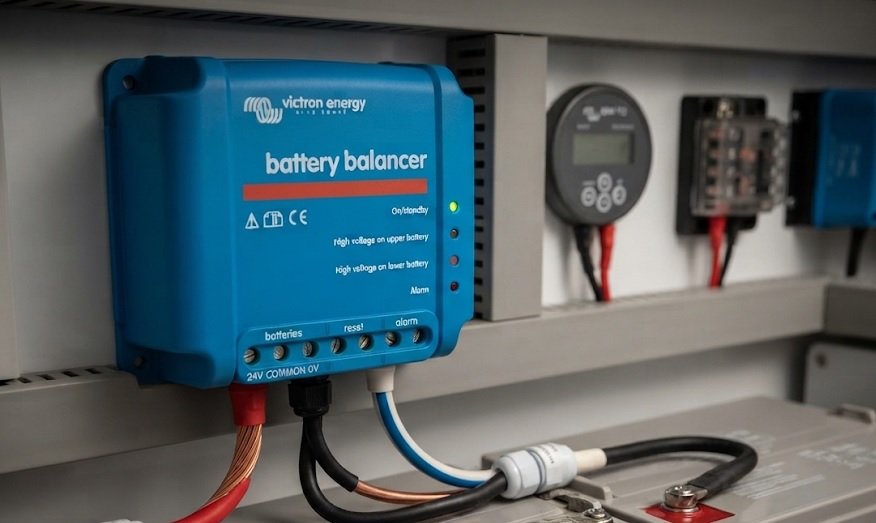
Bay Marine Battery Balancer BB-24V – Best Overall Choice
The Bay Marine BB-24V balancer actively equalizes charge between series-parallel strings, preventing imbalance before it starts. It handles 24V systems up to 120A and works with lead-acid, AGM, and lithium chemistries. Recommended for anyone running two or more batteries in parallel who wants automated protection.
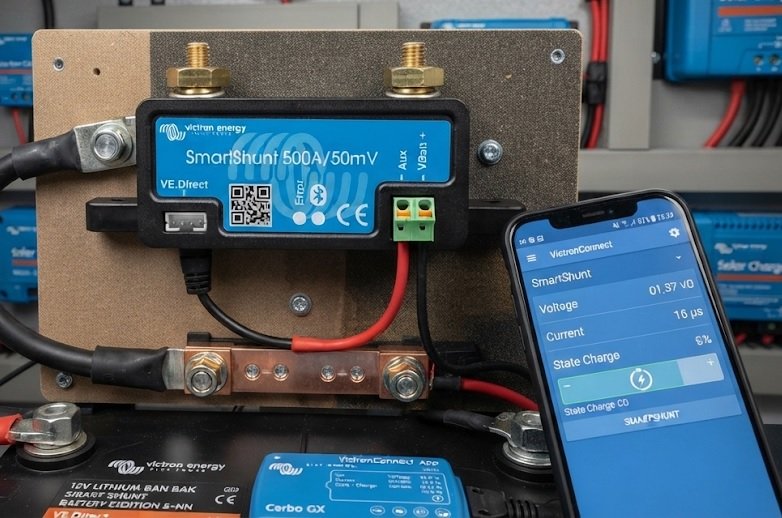
Victron Energy SmartShunt 500A – Best Monitoring Option
The Victron SmartShunt 500A tracks voltage, current, and state of charge across your parallel bank via Bluetooth. It reveals imbalance early, letting you correct wiring or weak cells fast. Ideal for solar and marine setups where real-time data prevents costly failures.
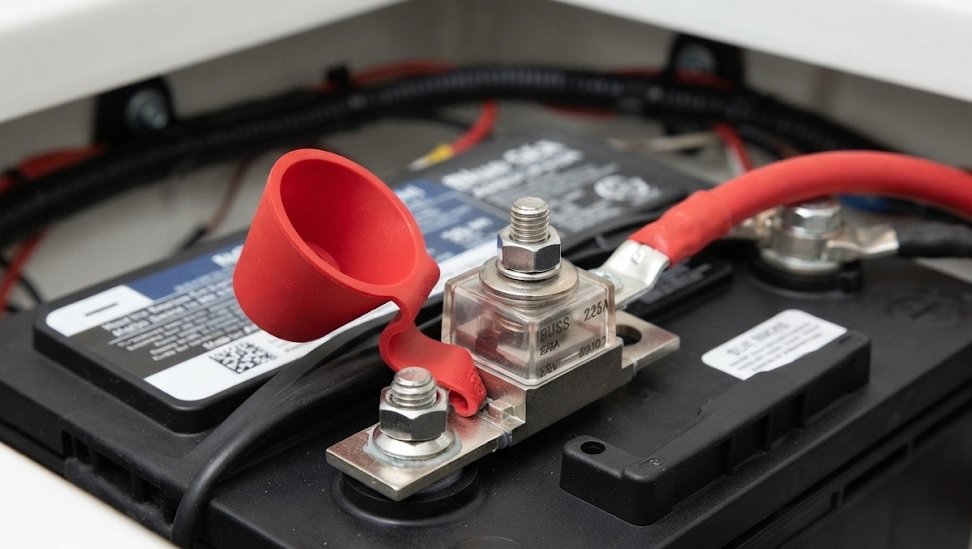
Blue Sea Systems 5191 MRBF Terminal Fuse Block – Best Safety Pick
The Blue Sea 5191 fuse block protects each parallel string with a 30-300A MRBF fuse, stopping runaway current if one battery shorts. Compact, corrosion-resistant, and rated to 58V DC. Best option for DIY builders who want affordable, code-compliant short-circuit protection.
What Causes Battery Imbalance in Parallel Connections
Battery imbalance happens when parallel batteries experience unequal current flow. One battery does more work, ages faster, and drags the whole bank down. Understanding the root causes helps you prevent it from the start.
Unequal Cable Resistance
Every cable has resistance, and longer or thinner wires add more. If one battery’s path to the load is shorter, it delivers more current than its neighbors.
- Cable length: Even 10 cm of difference shifts current distribution.
- Wire gauge: Thinner cables increase resistance and voltage drop.
- Terminal quality: Corroded or loose lugs create hot spots.
Mismatched Batteries
Batteries with different ages, capacities, or chemistries charge and discharge at different rates. The weakest cell becomes the limiting factor for the entire bank.
| Mismatch Type | Effect on Bank |
|---|---|
| Different age | Older battery drains newer ones |
| Different capacity | Lower Ah battery overcharges |
| Different chemistry | Voltage profiles conflict |
Poor Wiring Layout
Connecting the load to the first battery in a chain forces uneven current. The nearest battery works hardest, while the farthest barely contributes. Diagonal cross-connection solves this by balancing resistance across the whole bank.
Quick Summary
- Unequal cable resistance causes current hogging.
- Mismatched batteries create weak links.
- Diagonal wiring balances the load evenly.
How to Wire Batteries in Parallel Correctly Step by Step
Proper wiring is the foundation of a balanced battery bank. Follow these steps carefully, and always work with discharged, disconnected batteries for safety.
Step-by-Step Parallel Wiring Process
- Match your batteries: Use identical voltage, capacity, chemistry, and age.
- Connect all positives: Link every positive terminal to a common bus bar.
- Connect all negatives: Link every negative terminal to a second bus bar.
- Use equal-length cables: Keep every run the same length and gauge.
- Attach the load diagonally: Connect positive to battery one and negative to the last battery.
Choosing the Right Cable Size
Cable gauge must handle your total expected current plus a safety margin. Undersized cables overheat and waste energy as voltage drop.
- 100A draw: Use 4 AWG or larger for short runs.
- 200A draw: Step up to 1/0 AWG minimum.
- Long runs: Increase gauge to offset resistance.
Adding Fuses and Bus Bars
Install a fuse on each parallel string to isolate faults. A quality bus bar keeps connections clean and reduces resistance points. The Blue Sea 5191 is ideal for this role.
| Component | Purpose |
|---|---|
| Bus bar | Clean common connection point |
| MRBF fuse | Per-string short protection |
| Equal cables | Balanced resistance |
Quick Summary
- Match batteries and use equal-length cables.
- Wire the load diagonally for balance.
- Fuse each string and use a bus bar.
Maintaining Balance and Monitoring Your Parallel Battery Bank
Even a perfectly wired bank drifts over time. Regular monitoring and maintenance keep your batteries balanced and extend their service life.
How to Check for Battery Imbalance
Test each battery individually while the bank rests and under load. A healthy parallel bank shows voltage within 0.05V across all units.
- Resting voltage: Compare each battery after 2-4 hours offline.
- Under-load voltage: Watch for one battery sagging faster.
- Temperature: A hot battery signals current hogging.
Tools That Simplify Monitoring
A battery monitor reveals imbalance before damage occurs. The Victron SmartShunt 500A tracks state of charge and current across your whole bank via Bluetooth.
| Tool | What It Detects |
|---|---|
| Multimeter | Per-battery voltage drift |
| SmartShunt | Bank current and SOC |
| Balancer | Automatic charge equalizing |
Routine Maintenance Tips
Small habits prevent big problems. Clean terminals, torque connections, and equalize flooded batteries periodically.
- Monthly: Inspect terminals for corrosion and tightness.
- Quarterly: Recheck voltage balance across all batteries.
- Annually: Load-test each battery individually.
Quick Summary
- Check voltage within 0.05V across batteries.
- Use a shunt or balancer for early detection.
- Inspect terminals monthly and load-test yearly.
Common Mistakes to Avoid When Connecting Batteries in Parallel
Even experienced DIYers make errors that cause imbalance. Avoiding these pitfalls saves money, time, and safety risks.
Wiring and Connection Errors
Small wiring shortcuts create big imbalance problems. Always prioritize symmetry over convenience.
- Daisy-chaining the load: Connect to the first battery and the last one drains unevenly.
- Unequal cable lengths: Different resistance means different current flow.
- Skipping fuses: One shorted battery can melt the entire bank’s wiring.
Battery Selection Mistakes
Mixing batteries is the fastest way to kill a parallel bank. The weakest unit always drags the strongest down.
| Mistake | Consequence |
|---|---|
| Mixing old and new | New battery overcharges, old one undercharges |
| Mixing capacities | Lower Ah battery cycles harder |
| Mixing chemistries | Voltage profiles never align |
Charging and Safety Oversights
Improper charging accelerates imbalance and shortens battery life. Follow the manufacturer’s voltage and current specs closely.
- Undersized charger: Slow charging leaves cells unbalanced.
- Overcharging: Excess voltage damages weaker batteries first.
- Ignoring heat: Warm terminals signal resistance or current hogging.
Quick Summary
- Never daisy-chain the load connection.
- Match age, capacity, and chemistry exactly.
- Use the correct charger and watch for heat.
Parallel vs Series-Parallel: Which Configuration Prevents Imbalance Best
Choosing the right configuration affects balance, voltage, and total capacity. Each setup suits different applications and load requirements.
Parallel vs Series vs Series-Parallel Compared
Parallel keeps voltage the same while adding capacity. Series raises voltage while keeping capacity fixed. Series-parallel combines both for higher voltage and capacity.
| Configuration | Voltage | Capacity | Balance Risk |
|---|---|---|---|
| Parallel | Same | Adds up | Moderate |
| Series | Adds up | Same | High |
| Series-Parallel | Adds up | Adds up | Highest |
When Parallel Is the Best Option
Parallel wiring shines when you need more runtime at a fixed voltage. It’s ideal for 12V solar banks, RVs, and marine house systems.
- 12V systems: Add capacity without changing voltage.
- Redundancy: One failed battery won’t kill the bank.
- Simple charging: Standard chargers work without adjustment.
Why Series-Parallel Needs Extra Care
Series-parallel banks multiply imbalance risks because both voltage and capacity strings must stay matched. A balancer like the Bay Marine BB-24V becomes essential here.
- Match every string: Each series group must mirror the others.
- Use balancers: Active equalizing prevents drift between strings.
- Monitor closely: Imbalance hides easily in complex banks.
Quick Summary
- Parallel adds capacity; series adds voltage.
- Parallel suits 12V solar, RV, and marine banks.
- Series-parallel demands balancers and matching.
Safety Precautions for Parallel Battery Connections
Batteries store enormous energy and can deliver thousands of amps into a short circuit. Proper safety practices protect you and your equipment.
Personal Safety Essentials
Always treat every battery as live and dangerous. One wrong move can cause burns, fire, or explosion.
- Wear safety glasses: Acid splashes and sparks are real risks.
- Remove jewelry: Metal rings and watches can short terminals.
- Work in ventilated areas: Flooded batteries emit explosive hydrogen gas.
Electrical Safety Rules
Correct connections prevent arcing and catastrophic failures. Follow these rules every time you wire a bank.
- Disconnect the negative first and reconnect it last.
- Insulate tools to prevent accidental shorts across terminals.
- Fuse every string near the battery terminal.
- Verify polarity with a multimeter before energizing.
- Torque terminals to the manufacturer’s specification.
Handling Damaged or Swollen Batteries
A swollen, leaking, or hot battery is a hazard, not a project. Remove it from the bank immediately and replace it with a matched unit.
- Swollen case: Internal damage; never recharge.
- Leaking electrolyte: Neutralize with baking soda and dispose properly.
- Excess heat: Indicates internal short or overcharge.
Quick Summary
- Wear eye protection and remove metal jewelry.
- Disconnect negative first, fuse every string.
- Remove swollen or leaking batteries immediately.
Real-World Applications for Balanced Parallel Battery Banks
Parallel battery banks power many systems where runtime matters more than voltage. Each application has unique balance demands worth understanding.
Solar and Off-Grid Storage
Solar banks charge and discharge daily, so imbalance compounds quickly. Equal cable lengths and matched batteries keep every cell cycling evenly.
- 12V off-grid: Parallel batteries extend nighttime runtime.
- 24V/48V systems: Series-parallel strings need balancers.
- Daily cycling: Even wear maximizes bank lifespan.
RV, Marine, and Van Life Systems
Mobile setups face vibration, temperature swings, and irregular charging. Robust connections and fuses prevent failures on the road or water.
- House banks: Parallel AGM or lithium batteries power appliances.
- Starting banks: Keep separate from house loads.
- Shore charging: Use chargers matched to total bank capacity.
UPS and Backup Power
Backup banks sit idle for months, then must deliver full current instantly. Imbalance here means a failed backup when you need it most.
- Float charging: Maintains balance during long idle periods.
- Periodic testing: Load-test each battery quarterly.
- Temperature control: Cool, stable rooms extend life.
| Application | Balance Priority |
|---|---|
| Solar off-grid | Daily cycling evenness |
| RV and marine | Vibration-proof connections |
| UPS backup | Idle float stability |
Quick Summary
- Solar banks need matched cables for daily cycling.
- Mobile systems require robust, fused connections.
- Backup banks depend on float charging and testing.
Conclusion: Connect Batteries in Parallel the Right Way
Connecting batteries in parallel without imbalance comes down to matching, symmetry, and monitoring. Equal cables, diagonal wiring, and fuses keep every battery working evenly.
Remember the golden rule: balance resistance, balance current. Test voltage regularly and replace weak units fast.
Grab your multimeter, plan your layout, and wire with confidence today.
With these proven methods, your battery bank will deliver reliable power for years.
Frequently Asked Questions About Connecting Batteries in Parallel
What is the best way to connect batteries in parallel without imbalance?
Use identical batteries and equal-length cables, then connect the load diagonally. Link the positive to the first battery and the negative to the last one.
This balances resistance across the whole bank. Add a fuse to each string and torque every terminal to spec for reliable, even current flow.
Can I connect batteries of different ages or capacities in parallel?
No, you should avoid mixing batteries of different ages, capacities, or chemistries. The weakest unit limits the entire bank and drains stronger batteries.
If you must combine batteries, use matched units from the same batch. Replace the whole bank together when one battery fails to keep performance balanced.
How do I know if my parallel batteries are imbalanced?
Measure each battery’s voltage after resting for two to four hours. A healthy bank stays within 0.05V across all units.
Watch for one battery running hot or sagging under load. A battery monitor like the Victron SmartShunt reveals imbalance early before damage occurs.
Which is better for battery balance, parallel or series wiring?
Parallel wiring keeps voltage constant and adds capacity, making balance easier to manage. Series wiring raises voltage but increases imbalance risk between cells.
Series-parallel banks need active balancers because both voltage and capacity strings must stay matched. For simple 12V systems, parallel is usually the best option.
What size cables do I need for parallel battery connections?
Size cables to handle your total current plus a safety margin. For 100A draws, use 4 AWG or larger; for 200A, step up to 1/0 AWG.
Keep every cable the same length and gauge to equalize resistance. Longer runs require thicker wire to offset voltage drop and prevent overheating.
Do I need a fuse on each battery in a parallel bank?
Yes, fuse every parallel string near the battery terminal. A single shorted battery can dump enormous current and melt wiring or cause a fire.
Use an MRBF or ANL fuse rated for your system’s voltage and current. The Blue Sea 5191 fuse block is an affordable, code-compliant choice.
How often should I check my parallel battery bank?
Inspect terminals monthly for corrosion and tightness. Recheck voltage balance quarterly and load-test each battery annually.
Frequent checks catch imbalance early and extend battery life. Keep a simple log of readings so you can spot trends before failures happen.
Can I charge parallel batteries with a single charger?
Yes, one charger can charge a parallel bank if its amperage suits the total capacity. Match charger output to roughly 10-20% of bank Ah.
Connect the charger leads diagonally, just like the load, to keep charging even. An undersized charger leaves cells unbalanced and slows recharge times.