
Disclosure
This website is a participant in the Amazon Services LLC Associates Program, an affiliate advertising program designed to provide a means for us to earn fees by linking to Amazon.com and affiliated sites.
A 100Ah battery typically powers a CPAP machine for 2 to 4 nights when using a standard 50–60W unit with humidifier and heated tube turned off. Real-world runtime depends on your specific device settings and battery type.
This complete guide breaks down exact runtime calculations, real-world consumption data, and expert tips to extend your nights per charge. Read on for proven methods to maximize every amp-hour for reliable sleep therapy off-grid.
Key Takeaways
- 2–4 nights is typical runtime for most CPAP machines on a 100Ah battery.
- Humidifier and heated tube can cut runtime by 50% or more.
- Lithium (LiFePO4) batteries deliver 80–100% usable capacity; lead-acid only 50%.
- Formula: Battery Wh ÷ CPAP watts = approximate runtime hours.
- DC power avoids inverter losses, adding up to 15% more runtime.
Best 100Ah Batteries for CPAP Machines — Detailed Comparison
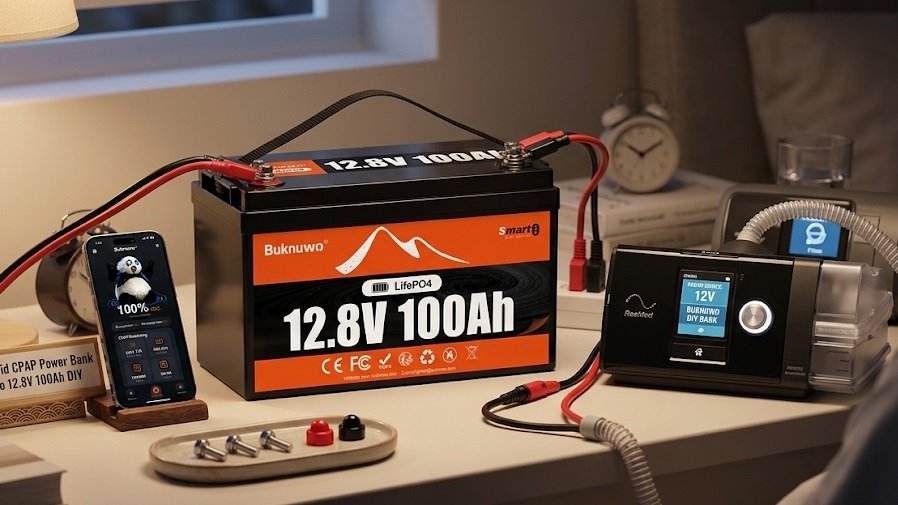
Bioenno Power BLF-12100A — Best Overall Choice
The Bioenno Power BLF-12100A is a 12V 100Ah LiFePO4 battery recommended for nightly CPAP users. Its 1,200Wh capacity and 2,000+ cycle life deliver roughly 3–4 nights per charge. Lightweight, safe, and ideal for home backup or camping.
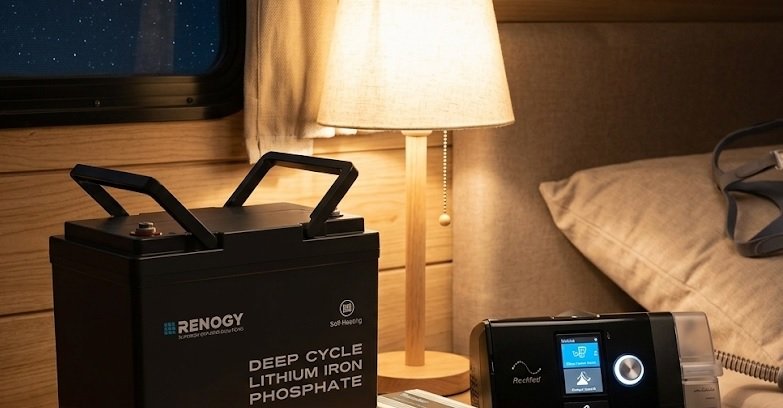
Renogy RBT100LFP12S — Best Value Option
The Renogy RBT100LFP12S offers a 12V 100Ah LiFePO4 build at a lower price point. With 1,280Wh usable energy and built-in BMS protection, it’s the best option for budget-conscious CPAP users wanting 2–4 nights of reliable runtime.
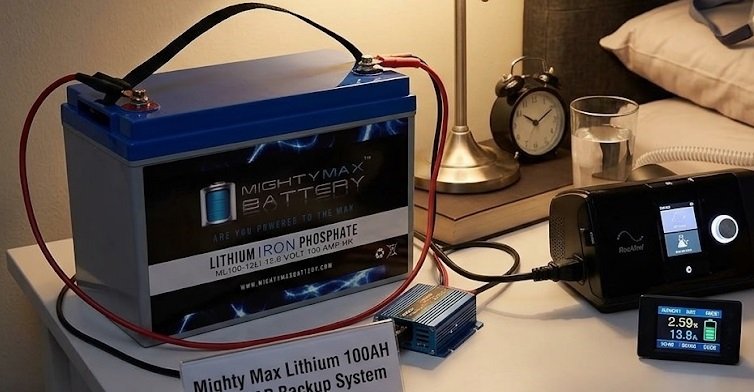
Battle Born BB10012 — Best Premium Choice
The Battle Born BB10012 is a 12V 100Ah LiFePO4 battery built in the USA with a 10-year warranty. Its 1,280Wh capacity and rugged design make it ideal for frequent travelers seeking maximum reliability and long-term CPAP power.
How Many Nights Can a 100Ah Battery Run a CPAP Machine?
A 100Ah battery stores roughly 1,200Wh of usable energy (lithium). Most CPAP machines draw between 30W and 60W per hour. That math determines your total nights of sleep therapy.
The Basic Runtime Formula for CPAP Battery Life
Use this simple equation to estimate your runtime:
- Find battery watt-hours: 100Ah × 12V = 1,200Wh
- Find CPAP wattage: Check your device label or manual
- Divide: 1,200Wh ÷ CPAP watts = runtime hours
- Divide by 8: Runtime hours ÷ 8 = total nights
For example, a 60W CPAP yields 20 hours, or about 2.5 nights of 8-hour sleep.
Real-World Runtime Examples by CPAP Model
Actual consumption varies by machine and pressure settings. Here’s how popular models perform on a 100Ah lithium battery:
| CPAP Model | Avg Draw | Nights (8hr) |
|---|---|---|
| ResMed AirSense 10 | ~53W | 2–3 |
| ResMed AirSense 11 | ~50W | 2–3 |
| Philips DreamStation 2 | ~45W | 3 |
| ResMed AirMini | ~20W | 5–6 |
Why Battery Chemistry Changes Everything
Battery type dramatically affects usable capacity. This is the most overlooked factor in CPAP runtime planning.
- LiFePO4: 80–100% usable — full 100Ah available
- Lead-acid: Only 50% usable — effectively 50Ah
- AGM: 50–60% usable with voltage sag under load
Choosing lithium effectively doubles your nights compared to lead-acid at the same rating.
How to Extend CPAP Runtime on a 100Ah Battery
You can often double your nights without buying a bigger battery. Small setting changes cut power draw dramatically. Here are the most effective proven methods.
Turn Off the Humidifier and Heated Tube
These two features are the biggest power drains on any CPAP setup. Disabling them is the single fastest way to extend runtime.
- Humidifier: Adds 20–40W — can cut runtime by half
- Heated tube: Adds 10–20W depending on climate setting
- Combined savings: Up to 60% less power consumption
Use a passive heat-moisture exchanger (HME) instead for comfortable, low-power humidification.
Use a DC Power Adapter Instead of an Inverter
Inverters convert 12V DC to 120V AC, wasting 10–15% of energy as heat. A direct DC adapter for your CPAP model bypasses this loss entirely.
- Buy the manufacturer’s 12V DC cord for your device
- Connect directly to the battery terminals
- Skip the inverter and save up to 15% capacity
Lower Pressure and Enable Airplane Mode
Reducing pressure settings and disabling wireless features squeezes out extra hours each night.
- Airplane mode: Turns off cellular and Wi-Fi radios
- Lower max pressure: Reduces motor workload
- EPR settings: Exhale relief can slightly lower draw
Always consult your sleep doctor before changing prescribed pressure settings.
Quick Wins
- Humidifier off = biggest single gain
- DC adapter = 10–15% more runtime
- Airplane mode = small but free savings
Choosing the Right 100Ah Battery for CPAP Use
Not all 100Ah batteries perform equally for sleep therapy. Chemistry, weight, and charging speed matter as much as raw capacity. Here’s what to prioritize before buying.
Lithium vs. Lead-Acid for CPAP Machines
Lithium (LiFePO4) wins for nearly every CPAP application. It delivers more usable energy, lasts longer, and weighs far less.
| Factor | LiFePO4 | Lead-Acid |
|---|---|---|
| Usable Capacity | 80–100Ah | 50Ah |
| Weight | ~26 lbs | ~65 lbs |
| Cycle Life | 2,000–5,000 | 300–500 |
| Cost Per Night | Lower long-term | Higher long-term |
Key Features to Look For Before Buying
Prioritize safety, monitoring, and compatibility with your specific CPAP model.
- Built-in BMS: Protects against overcharge and over-discharge
- 12V output: Matches most CPAP DC adapters directly
- Anderson or ring terminals: Simplifies secure connections
- Cold-weather rating: Essential for camping in low temperatures
Matching Battery Capacity to Trip Length
Size your battery to your longest planned trip, not your average night. This prevents mid-trip power failures.
- Weekend trips (2–3 nights): Single 100Ah lithium works
- Week-long trips: Bring solar or a second battery
- Home backup: 100Ah covers 2–4 nights reliably
Pairing your battery with a 100–200W solar panel can extend off-grid use indefinitely.
Buying Checklist
- Choose LiFePO4 over lead-acid
- Confirm 12V DC compatibility
- Add solar for trips over 3 nights
Safety and Charging Tips for CPAP Battery Systems
Proper charging and storage protect both your battery and your CPAP equipment. Mistakes here shorten battery life and create real safety risks. Follow these guidelines for reliable, long-term performance.
How to Charge a 100Ah Battery Safely
Use a charger matched to your battery’s chemistry and voltage. Mismatched chargers damage cells or fail to reach full capacity.
- Use a lithium-specific charger for LiFePO4 batteries
- Charge in a ventilated area away from flammable materials
- Recharge after each use — avoid storing below 50%
- Store at 50–70% charge for long-term storage
Most 100Ah lithium batteries recharge in 4–6 hours with a 20A charger.
Common Safety Mistakes to Avoid
Small oversights cause most battery failures and hazards. Avoid these pitfalls.
- Never discharge below 20% — deep discharges shorten lifespan
- Don’t charge below freezing without a heated BMS
- Avoid daisy-chaining mismatched batteries
- Never cover vents or enclose batteries tightly
Storing Your Battery Between Trips
Correct storage preserves capacity for years. Temperature and charge level are the two critical factors.
- Ideal temperature: 50–77°F (10–25°C)
- Charge level: 50–70% for storage over one month
- Check monthly: Top up if voltage drops
Following these habits can extend battery life well beyond 2,000 cycles.
Safety Essentials
- Match charger to battery chemistry
- Never drain below 20%
- Store at 50–70% in mild temperatures
Real-World CPAP Battery Setups and Costs
Understanding actual costs and setups helps you plan realistically. Here are practical configurations real users rely on for camping, travel, and emergencies.
Sample Setup Costs at a Glance
Budget depends on whether you need a battery only or a complete portable system.
| Setup Type | Components | Est. Cost |
|---|---|---|
| Basic | 100Ah LiFePO4 + DC adapter | $400–$600 |
| Mid-Range | Battery + charger + solar panel | $700–$1,000 |
| Premium | Battle Born + solar + case | $1,200–$1,800 |
Best Use Cases for a 100Ah CPAP Battery
Different scenarios demand different priorities. Match your setup to how you’ll actually use it.
- Camping (2–3 nights): Single lithium battery, no solar needed
- Extended off-grid trips: Battery plus 100–200W solar panel
- Home power outages: Keep battery charged year-round
- Air travel: Choose FAA-compliant batteries under 100Wh per cell
What Real Users Report
Actual runtime often differs from lab specs. User experiences reveal the real-world range.
- Most report 2–3 nights with humidifier off
- AirMini users report up to 5–6 nights
- Lead-acid users report only 1–2 nights
These figures confirm that battery chemistry and settings matter more than advertised capacity.
Real-World Reality
- Budget $400–$1,800 depending on setup
- Humidifier off = 2–3 reliable nights
- Solar extends trips indefinitely
Comparing Battery Types for CPAP Power Backup
Chemistry choice affects runtime, weight, lifespan, and total cost. Understanding the tradeoffs helps you pick the right battery for your CPAP needs. Here’s how the main options stack up.
LiFePO4 vs. AGM vs. Gel Batteries
Each chemistry offers distinct advantages depending on your budget and use case. Lithium leads on nearly every metric except upfront price.
| Feature | LiFePO4 | AGM | Gel |
|---|---|---|---|
| Usable Capacity | 80–100% | 50–60% | 50% |
| Cycle Life | 2,000–5,000 | 300–500 | 500–700 |
| Weight (100Ah) | ~26 lbs | ~65 lbs | ~70 lbs |
| Upfront Cost | Higher | Lower | Moderate |
Which Battery Type Fits Your Situation?
Match chemistry to how often you’ll use the battery and how portable it needs to be.
- Frequent travelers: LiFePO4 for weight and cycle life
- Home backup only: AGM is budget-friendly and stationary
- Cold climates: LiFePO4 with heated BMS or gel
- Occasional campers: AGM works if weight isn’t an issue
Total Cost of Ownership Over Time
Upfront price hides the real story. Calculate cost per usable night to compare fairly.
- LiFePO4: $600 ÷ 2,500 cycles = $0.24 per cycle
- AGM: $250 ÷ 400 cycles = $0.63 per cycle
- Gel: $350 ÷ 600 cycles = $0.58 per cycle
Lithium costs more upfront but delivers 2–3x lower lifetime cost.
Chemistry Comparison
- LiFePO4 wins on weight and lifespan
- AGM suits stationary home backup
- Lithium costs less per cycle long-term
Frequently Overlooked Factors That Affect CPAP Runtime
Beyond settings and chemistry, several hidden variables quietly drain your battery. Accounting for them prevents unpleasant surprises mid-trip. Here are the factors most users miss.
Temperature and Altitude Effects on Battery Performance
Cold temperatures reduce usable capacity in all battery types. Altitude changes how hard your CPAP motor works to deliver pressure.
- Below 32°F: Lithium loses 10–20% capacity
- Below 50°F: Lead-acid loses up to 30%
- High altitude: CPAP motor draws more power
- Solution: Insulate batteries or store them warm
Mask Leaks and Pressure Settings
A leaky mask forces the motor to work harder all night. This silently increases power draw by 10–25%.
- Check mask fit before every trip
- Replace cushions every 3–6 months
- Run the mask fit test on your device
- Lower max pressure only with doctor approval
Fixing a leak is free and instantly boosts runtime.
Battery Age and State of Health
Batteries lose capacity as they age, even with careful use. An older battery delivers fewer nights than its rating suggests.
- Year 1: Near 100% capacity
- Year 3: 90–95% capacity
- Year 5+: 80% or less
Test capacity annually to plan trips accurately and avoid mid-night shutdowns.
Hidden Runtime Killers
- Cold cuts capacity up to 30%
- Mask leaks add 10–25% draw
- Aging batteries lose capacity yearly
Conclusion: Powering Your CPAP with a 100Ah Battery
A 100Ah battery reliably powers most CPAP machines for 2 to 4 nights. Turning off the humidifier and using a DC adapter stretches every amp-hour further.
Choose LiFePO4 for the best weight, lifespan, and usable capacity. Match your setup to your trip length and budget.
Ready to sleep better off-grid? Pick your battery, test your runtime at home, and pack with confidence.
With the right setup, peaceful, uninterrupted sleep therapy is always within reach.
Frequently Asked Questions About a 100Ah Battery and CPAP Machines
How many nights will a 100Ah battery run my CPAP machine?
Most CPAP machines run 2 to 4 nights on a 100Ah lithium battery. Runtime depends on your device wattage, pressure settings, and whether the humidifier is on.
With the humidifier and heated tube disabled, expect closer to 3–4 nights. Heated features can cut runtime by half or more.
Can I run my CPAP directly from a 100Ah battery?
Yes, most 12V CPAP machines run directly from a 100Ah battery using a DC power adapter. This avoids inverter losses and adds up to 15% more runtime.
Always use the manufacturer-approved DC cord for your specific model. Connecting directly also reduces energy waste and keeps your setup simpler.
Is lithium or lead-acid better for CPAP battery backup?
Lithium (LiFePO4) is the better choice for CPAP backup. It offers 80–100% usable capacity, weighs far less, and lasts 2,000–5,000 cycles.
Lead-acid only delivers about 50% usable capacity and weighs roughly 65 pounds. Lithium costs more upfront but delivers a lower cost per night.
How do I calculate my CPAP runtime on a 100Ah battery?
Multiply 100Ah by 12V to get 1,200Wh. Then divide by your CPAP’s wattage and divide again by 8 for nights.
For example, a 60W CPAP yields 20 hours, or about 2.5 nights. Check your device label for accurate wattage before calculating.
Does turning off the humidifier really extend battery life?
Yes, disabling the humidifier is the single biggest runtime saver. It can add 20–40W of draw, cutting runtime by up to half.
Use a passive heat-moisture exchanger (HME) instead. It provides comfortable humidification with almost no power consumption.
Can I charge a 100Ah battery with solar while camping?
Yes, a 100–200W solar panel can recharge a 100Ah battery during daylight. This extends off-grid trips almost indefinitely in good sun.
Pair your panel with an MPPT charge controller for maximum efficiency. Solar is the best way to stay powered on extended trips.
Why is my CPAP battery draining faster than expected?
Common causes include mask leaks, cold temperatures, and an aging battery. A leaky mask forces the motor to work harder all night.
Test your battery capacity annually and check mask fit before each trip. These simple steps prevent unexpected mid-night shutdowns.
What size battery do I need for a week-long CPAP trip?
A single 100Ah battery covers only 2–4 nights. For a full week, bring two batteries or pair one with a 100–200W solar panel.
Solar charging during the day replenishes power for nightly use. This combination keeps your CPAP running reliably for the entire trip.