
Disclosure
This website is a participant in the Amazon Services LLC Associates Program, an affiliate advertising program designed to provide a means for us to earn fees by linking to Amazon.com and affiliated sites.
Learning how to connect batteries in series for 24V lets you double your voltage output while keeping the same amp-hour capacity. This simple wiring method powers trolling motors, solar banks, and RV systems efficiently.
This complete guide covers battery selection, step-by-step wiring, expert safety tips, and proven methods for testing your 24V setup. Keep reading to build a reliable, long-lasting battery bank with confidence.
Key Takeaways
- Series wiring adds voltage: two 12V batteries equal 24V, while amp-hour capacity stays the same.
- Match batteries by brand, age, and capacity to prevent imbalance and early failure.
- Connect positive to negative, then use a multimeter to confirm 24V before powering devices.
- Never mix series and parallel wiring without understanding the voltage and capacity trade-offs.
Best Batteries for Connecting in Series for 24V – Detailed Comparison
Choosing the right batteries makes your 24V build safer and longer-lasting. The three options below are recommended for series wiring based on capacity, chemistry, and value.
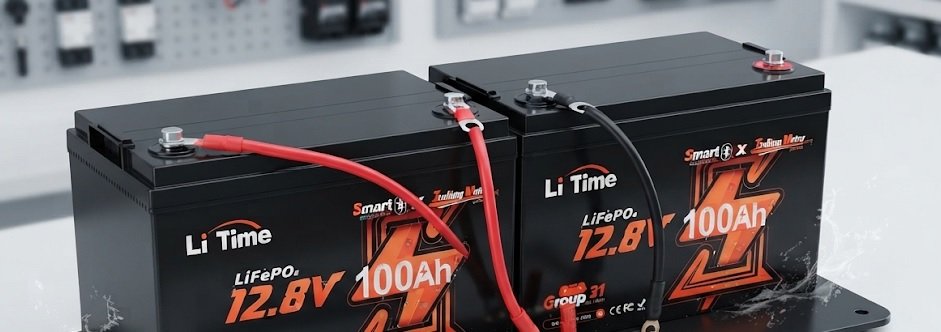
LiTime 12V 100Ah LiFePO4 Battery – Best Overall Choice
The LiTime 12V 100Ah LiFePO4 is the best option for most 24V builds. Its built-in BMS manages cell balance, and 4,000+ charge cycles outlast lead-acid rivals. Lightweight, maintenance-free, and ideal for solar, RV, and trolling motor setups.
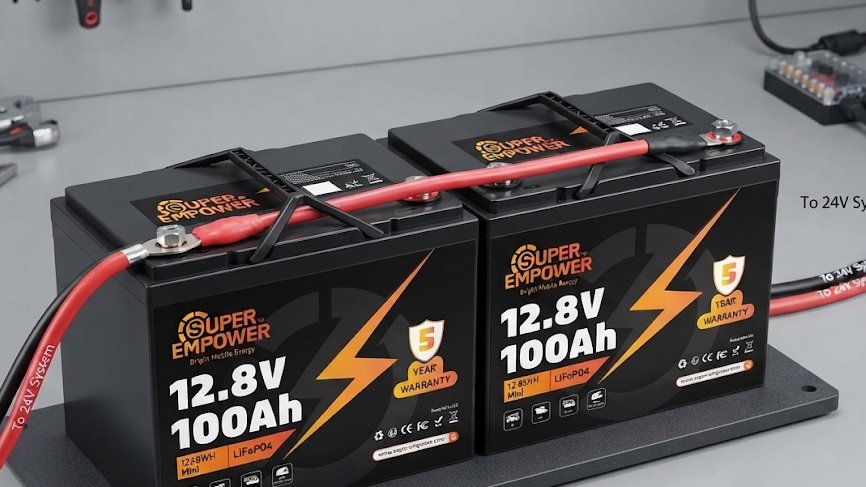
Battle Born 12V 100Ah LiFePO4 Battery – Best Premium Option
The Battle Born 12V 100Ah delivers premium reliability with a 10-year warranty and American-based support. Its robust BMS handles heavy loads and deep discharges, making it ideal for off-grid cabins and marine systems where dependability matters most.
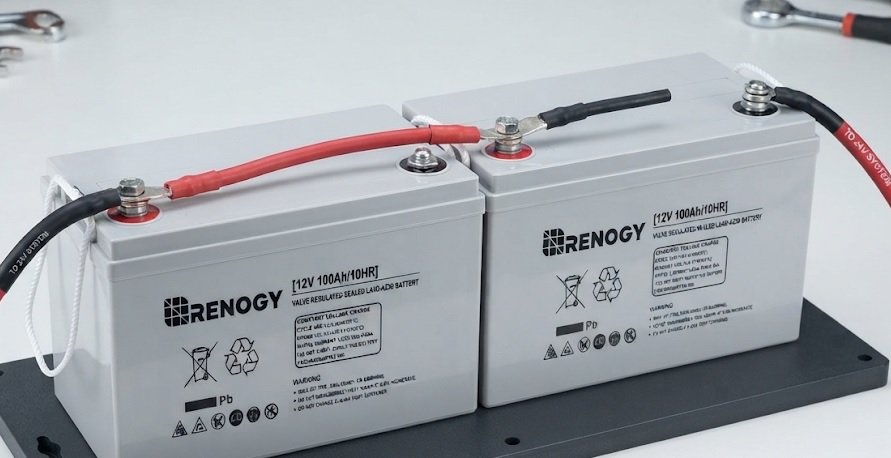
Renogy 12V 100Ah Deep Cycle AGM Battery – Best Budget Option
The Renogy 12V 100Ah AGM is the recommended budget pick for beginners. It is sealed, spill-proof, and affordable, handling moderate 24V demands well. Ideal for backup power and small solar banks where upfront cost outweighs cycle life.
How to Wire Two 12V Batteries in Series for a 24V System
Connecting two 12V batteries in series is the fastest way to reach 24V. The process takes minutes and requires only basic tools. Follow these steps carefully to avoid damage or injury.
Tools and Materials You Will Need
- Two matching 12V batteries of equal age and capacity
- Insulated jumper cables or series connection cables
- Multimeter for voltage testing
- Wrench and safety gloves
Step-by-Step Series Wiring Instructions
- Disconnect all loads and turn off chargers before starting.
- Connect the positive terminal of Battery A to the negative terminal of Battery B using one cable.
- Leave the remaining positive and negative terminals open — these become your 24V output.
- Test with a multimeter: place probes on the open terminals. You should read approximately 24V.
If your reading is near 12V, your wiring is wrong. Recheck the jumper cable placement before continuing.
Understanding Voltage vs. Capacity in Series
Series wiring adds voltage but keeps amp-hour capacity unchanged. Two 12V 100Ah batteries produce 24V at 100Ah, not 200Ah.
| Configuration | Voltage | Capacity |
|---|---|---|
| Single battery | 12V | 100Ah |
| Two in series | 24V | 100Ah |
| Two in parallel | 12V | 200Ah |
Need more runtime instead of voltage? Wire in parallel. Need 24V? Stay with series.
Safety Tips and Common Mistakes When Connecting Batteries in Series
Series wiring is simple, but small errors cause big problems. These expert tips prevent damage, fire risks, and shortened battery life. Review them before every build.
Essential Safety Precautions for 24V Battery Banks
- Wear insulated gloves and eye protection to guard against sparks and acid.
- Work in a ventilated area away from flames or ignition sources.
- Disconnect the negative terminal first when removing batteries.
- Use a fuse or breaker rated for your system’s amperage on the positive output.
Most Common Series Wiring Mistakes to Avoid
- Mixing old and new batteries: mismatched ages cause uneven charging and early failure.
- Using different brands or capacities: always pair identical models.
- Forgetting the BMS: LiFePO4 batteries need a BMS rated for 24V series use.
- Skipping the voltage test: always confirm 24V before connecting devices.
Quick Safety Rules
- Match batteries by brand, age, and capacity
- Test voltage before powering any load
- Install a fuse on the positive output
Charging Your 24V Series Battery Bank
Use a 24V charger or a 12V charger with each battery charged separately. Never charge mismatched batteries together. Proper charging extends cycle life and keeps cells balanced.
Series vs. Parallel vs. Series-Parallel: Which 24V Setup Is Right for You?
Series is not the only wiring option. Understanding the differences helps you match your battery bank to real power needs. Compare all three configurations below.
Series vs. Parallel Wiring: Key Differences
- Series: doubles voltage, keeps amp-hours the same (12V + 12V = 24V, 100Ah)
- Parallel: doubles capacity, keeps voltage the same (12V, 200Ah)
- Series-parallel: doubles both voltage and capacity (24V, 200Ah with four batteries)
When to Choose Series-Parallel for 24V
Need 24V and longer runtime? Wire two pairs in series, then connect the pairs in parallel. Four 12V 100Ah batteries yield 24V at 200Ah — ideal for larger solar banks and extended off-grid use.
| Configuration | Batteries | Output |
|---|---|---|
| Series | 2 × 12V 100Ah | 24V, 100Ah |
| Parallel | 2 × 12V 100Ah | 12V, 200Ah |
| Series-Parallel | 4 × 12V 100Ah | 24V, 200Ah |
Choosing the Right Setup for Your Application
- Trolling motors: series for 24V thrust
- Solar banks: series-parallel for voltage plus storage
- RV house power: parallel for 12V systems, series for 24V inverters
Quick Rule
- Series = more voltage
- Parallel = more runtime
- Series-parallel = both
Match the wiring method to your device’s voltage and runtime needs before you build.
Testing, Maintaining, and Troubleshooting Your 24V Battery Bank
A properly wired 24V bank still needs regular testing and care. These steps keep performance strong and catch problems early. Follow them monthly for best results.
How to Test Your 24V Series Connection
- Set your multimeter to DC voltage (20V+ range).
- Touch the red probe to the open positive terminal.
- Touch the black probe to the open negative terminal.
- Confirm a reading near 24V (25.6V–26.4V for LiFePO4 at rest).
Also test each battery individually. Both should read nearly identical voltage — a gap signals imbalance.
Routine Maintenance Tips for Long Battery Life
- Check terminal connections monthly for corrosion or looseness.
- Keep batteries at similar temperatures to prevent uneven aging.
- Recharge promptly after discharge — avoid leaving cells depleted.
- Store at 50–60% charge if the bank sits unused for long periods.
Common 24V Problems and Quick Fixes
| Problem | Likely Cause | Fix |
|---|---|---|
| Reads 12V | Wrong jumper placement | Recheck series wiring |
| Uneven voltage | Mismatched batteries | Replace with matched pair |
| Weak runtime | Capacity loss | Load test each battery |
Maintenance Essentials
- Test voltage monthly
- Keep terminals clean and tight
- Recharge after every discharge
Real-World Applications: Where 24V Series Battery Banks Shine
A 24V series setup powers many everyday systems more efficiently than 12V. Lower current draw means thinner cables and less heat. Here are the most common real-world uses.
Top Applications for 24V Battery Systems
- Trolling motors: 24V delivers more thrust and longer run times on the water.
- Solar power banks: 24V reduces wiring losses across long panel runs.
- RV and van conversions: 24V inverters run appliances with greater efficiency.
- Off-grid cabins: 24V banks pair well with larger inverters and charge controllers.
- Marine electronics: 24V suits bow thrusters and larger onboard systems.
Why 24V Beats 12V for Larger Loads
Doubling voltage halves the current for the same wattage. That means smaller cables, less voltage drop, and cooler operation. For high-draw devices, 24V is simply more efficient.
| Factor | 12V System | 24V System |
|---|---|---|
| Current for 1000W | ~83A | ~42A |
| Cable size | Thicker | Thinner |
| Efficiency | Lower | Higher |
Matching Your 24V Bank to Device Requirements
Always confirm your device’s voltage range before wiring. Most 24V equipment tolerates 20V–29V, but check the manual. Undervoltage causes shutdowns; overvoltage risks damage.
Best Uses for 24V
- Trolling motors and marine gear
- Solar and off-grid banks
- RV inverters and larger loads
Battery Chemistry and Compatibility for 24V Series Connections
Not all batteries work well in series. Chemistry, age, and BMS compatibility decide whether your 24V bank thrives or fails early. Match these factors before wiring.
Lead-Acid vs. LiFePO4 in Series Wiring
- Lead-acid (AGM, gel, flooded): affordable and forgiving, but heavier with shorter cycle life.
- LiFePO4: lighter, 4,000+ cycles, and stable voltage — the best option for most 24V builds.
- Never mix chemistries: different charge profiles cause imbalance and damage.
Why Battery Matching Matters in Series
Series batteries share the same current, so weak cells drag down the whole bank. Always use identical brand, model, age, and capacity. Replace both batteries at once if one fails.
| Factor | Lead-Acid | LiFePO4 |
|---|---|---|
| Cycle life | 300–500 | 4,000+ |
| Weight | Heavy | Light |
| Maintenance | Regular | None |
| Cost upfront | Low | Higher |
BMS Requirements for Series LiFePO4 Banks
Each LiFePO4 battery needs a BMS rated for series use. Some BMS units support 24V, 48V, or higher. Confirm yours before connecting, or the bank may shut down unexpectedly.
Compatibility Checklist
- Same chemistry, brand, and age
- BMS rated for series voltage
- Replace mismatched batteries in pairs
Cost, Sizing, and Cable Selection for Your 24V Battery Build
Planning a 24V build means budgeting for batteries, cables, and safety gear. Smart sizing saves money and prevents dangerous overheating. Use these guidelines before you buy.
How to Size Cables for a 24V Series Bank
Higher voltage means lower current, so 24V systems use thinner, cheaper cables than 12V setups. Match cable gauge to your total amperage and run length.
| Current | Up to 3 ft | Up to 6 ft |
|---|---|---|
| Up to 40A | 8 AWG | 6 AWG |
| Up to 60A | 6 AWG | 4 AWG |
| Up to 100A | 4 AWG | 2 AWG |
Estimated Costs for Common 24V Configurations
- Budget AGM build: $300–$500 for two 12V 100Ah batteries plus cables.
- Mid-range LiFePO4: $700–$1,200 for two 12V 100Ah units.
- Premium series-parallel bank: $1,500+ for four high-end batteries.
Essential Accessories Worth the Investment
- Fuse or circuit breaker rated for system amperage.
- Battery monitor or shunt for real-time state-of-charge tracking.
- Proper terminal lugs and heat shrink for secure, corrosion-resistant connections.
- 24V-compatible charger sized to your bank’s capacity.
Budgeting Essentials
- 24V allows thinner cables than 12V
- Always fuse the positive output
- Add a battery monitor for accuracy
Conclusion: Connecting Batteries in Series for 24V Made Simple
Connecting batteries in series for 24V is a straightforward way to double voltage and boost efficiency. With matched batteries, correct wiring, and proper safety gear, your build will perform reliably for years.
Always test voltage, fuse the output, and maintain your bank monthly. These proven methods prevent costly mistakes and extend battery life.
Ready to power your project? Gather your tools, follow the steps above, and build your 24V system with confidence today.
Frequently Asked Questions about Connecting Batteries in Series for 24V
What happens when you connect two 12V batteries in series?
Connecting two 12V batteries in series adds their voltages together, producing 24V. The amp-hour capacity stays the same as a single battery.
For example, two 12V 100Ah batteries yield 24V at 100Ah. This makes series wiring ideal when your device needs higher voltage rather than more runtime.
Can I connect batteries of different brands or ages in series?
No, you should never mix batteries of different brands, ages, or capacities in series. Mismatched batteries charge unevenly and fail prematurely.
Series batteries share the same current, so the weakest cell limits the entire bank. Always use identical batteries and replace them in matched pairs.
How do I test if my 24V series connection is correct?
Use a multimeter set to DC voltage. Touch the red probe to the open positive terminal and the black probe to the open negative terminal.
A correct reading should show approximately 24V, or 25.6V–26.4V for LiFePO4 at rest. If you read near 12V, your jumper cable placement is wrong.
Which is better for a 24V system: series or series-parallel?
Series is best when you only need 24V with standard capacity. Series-parallel is better when you need 24V plus extra runtime.
Series-parallel uses four batteries to double both voltage and amp-hours. Choose it for larger solar banks or extended off-grid applications.
Can I charge a 24V series battery bank with a 12V charger?
No, a 12V charger cannot properly charge a 24V bank as a whole. You must use a 24V charger or charge each battery separately.
Charging each battery individually keeps cells balanced. Never charge mismatched batteries together, as this shortens their lifespan.
Why does my 24V battery bank lose power quickly?
Rapid power loss usually points to mismatched batteries, capacity loss, or poor connections. Test each battery individually with a load tester.
If one battery reads significantly lower voltage, replace the pair. Also check terminals for corrosion and tighten any loose connections.
What size cables do I need for a 24V series connection?
Because 24V draws less current than 12V, you can use thinner cables. Match gauge to your total amperage and cable run length.
For up to 40A and short runs, 8 AWG works well. For 100A, use 4 AWG or thicker to prevent voltage drop and overheating.
Do LiFePO4 batteries need a special BMS for series wiring?
Yes, each LiFePO4 battery needs a BMS rated for series use. Some BMS units only support 12V and will fail in a 24V configuration.
Confirm your BMS supports 24V before wiring. A compatible BMS balances cells and protects against overcharge, overdischarge, and short circuits.