Choosing the right fuse size for a 12V battery system is critical to prevent electrical fires and equipment damage. The correct fuse rating depends on your wire gauge, load requirements, and the total amperage your circuit draws during normal operation.
This complete guide breaks down proven methods for calculating fuse sizes, matching fuses to wire capacity, and avoiding costly mistakes. Keep reading to discover expert tips that will protect your battery, wiring, and connected devices.
Key Takeaways
- Size fuses at 125% of continuous load current for safe headroom.
- Never exceed your wire gauge’s ampacity rating — the fuse protects the wire first.
- Common 12V fuse sizes: 5A to 300A, matched to circuit draw.
- Use ANL or MEGA fuses for high-current main battery lines.
- Undersized fuses cause nuisance blows; oversized fuses risk fire.
Best Fuses for 12V Battery Systems – Detailed Comparison
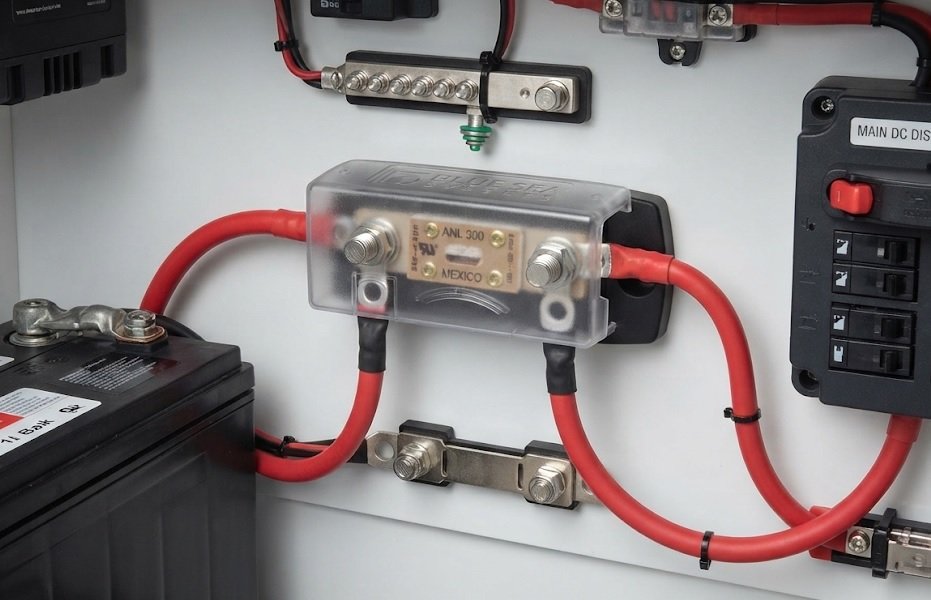
Blue Sea Systems ANL Fuse Block 5005 – Best Overall Choice
The Blue Sea Systems 5005 is the recommended option for high-current 12V battery banks. It handles 35A to 300A ANL fuses with a clear viewing window and ignition-protected rating. Ideal for main battery lines, inverters, and winch circuits requiring reliable, marine-grade protection.
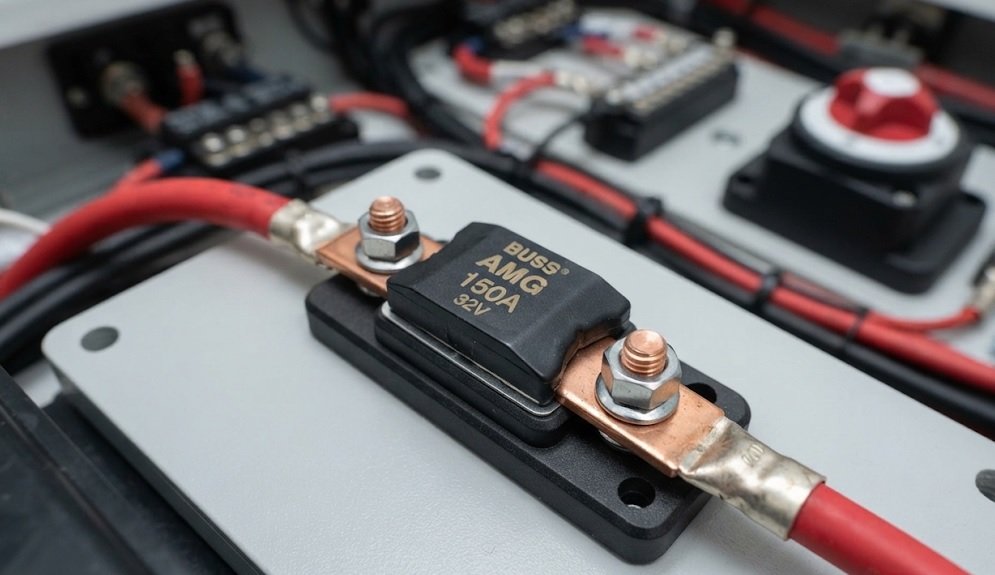
Bussmann AMG-150 MEGA Fuse – Best for High-Amperage Main Lines
The Bussmann AMG-150 delivers a 150A MEGA fuse rated for 32V DC systems. This best option suits heavy-duty applications like dual-battery setups and large inverters. Its bolt-down design ensures secure connections and minimal voltage drop under sustained loads.
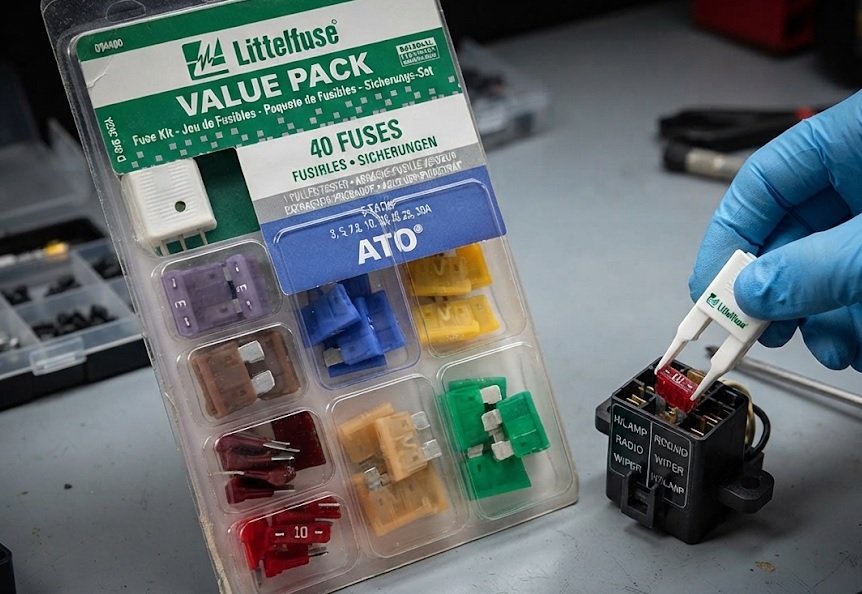
Littelfuse ATO ATC Blade Fuse Assortment – Best for Small Accessory Circuits
The Littelfuse ATO/ATC assortment covers 2A to 40A blade fuses, ideal for lights, radios, and dash cams. This affordable kit is perfect for 12V accessory wiring where quick replacement and standard sizing matter most. Great for DIY installers and mobile setups.
How to Calculate the Correct Fuse Size for a 12V Battery System
Getting the fuse size right starts with knowing your circuit’s continuous current draw and your wire’s ampacity. Follow this proven method to size any 12V fuse safely.
Step 1: Determine Your Continuous Load (Amps)
Add up the amp draw of every device on the circuit. Use watts ÷ 12V = amps for each item.
- LED light bar (60W): 5 amps
- 12V fridge (120W): 10 amps
- Inverter (1000W): ~83 amps continuous
Step 2: Apply the 125% Safety Rule
Multiply your total continuous amps by 1.25. This headroom prevents nuisance blows from inrush current and heat.
Example: A 20A load × 1.25 = 25A fuse. Round up to the nearest standard size.
Step 3: Match the Fuse to Your Wire Gauge
The fuse must never exceed the wire’s ampacity — the fuse protects the wire, not just the device.
| Wire Gauge (AWG) | Max Fuse Rating |
|---|---|
| 18 AWG | 10A |
| 14 AWG | 25A |
| 10 AWG | 40A |
| 4 AWG | 125A |
| 1/0 AWG | 300A |
Quick Formula
- Fuse size = Total amps × 1.25, then round up to the nearest standard rating.
Always choose the lower of the two limits: the calculated load fuse or the wire ampacity. Now let’s look at fuse types and installation.
Types of 12V Fuses and Where to Use Each One
Different circuits demand different fuse types. Choosing the wrong style can cause voltage drop, poor contact, or inadequate protection.
Blade Fuses (ATO, ATC, ATM)
These standard 2A–40A fuses suit low-power accessory circuits. They’re cheap, color-coded, and available everywhere.
- ATO/ATC: 2A–40A, standard size
- ATM/Mini: 2A–30A, tight spaces
- Maxi: 20A–80A, heavier loads
ANL, MEGA, and Class T Fuses
High-current fuses protect main battery lines and inverters. Class T fuses offer the highest interrupt rating for lithium systems.
- ANL: 35A–300A, common in marine and RV setups
- MEGA/AMG: 80A–500A, bolt-down design
- Class T: 200A–400A, fastest blow for lithium banks
Circuit Breakers vs. Fuses
Resettable breakers add convenience but cost more. Fuses remain the best option for one-time, high-interrupt protection.
| Type | Amperage Range | Best Use |
|---|---|---|
| Blade (ATO) | 2A–40A | Accessories, lights |
| ANL | 35A–300A | Main battery lines |
| Class T | 200A–400A | Lithium systems |
Quick Rule
- Match fuse type to amperage and interrupt rating — never just physical size.
With the right type selected, proper placement and installation complete the protection strategy.
Where to Install Fuses in a 12V Battery System
Correct placement is just as important as correct sizing. A properly rated fuse in the wrong location still leaves your system vulnerable.
Always Fuse at the Battery Source
Install the main fuse as close to the battery’s positive terminal as possible — ideally within 7 to 18 inches. This protects the entire cable run against short circuits.
- Within 18 inches: Standard for most 12V systems
- Within 7 inches: Recommended for lithium banks
- Never: Fuse only at the device end
Use Separate Fuses for Each Circuit
Branch circuits need individual protection sized to their wire and load. A single main fuse cannot protect small accessory wiring.
- Run a fused main line from the battery
- Feed a fuse block or distribution panel
- Add a dedicated fuse per branch circuit
Common Installation Mistakes to Avoid
- Oversized fuses: Allow wire to overheat before blowing
- Poor connections: Loose terminals cause voltage drop and heat
- Unfused grounds: Grounds rarely need fuses, but positive lines always do
- Wrong interrupt rating: Critical for lithium battery systems
Placement Rule
- Fuse within 18 inches of the battery positive terminal, and fuse every branch circuit separately.
Proper placement and sizing work together to deliver reliable, code-compliant protection for any 12V setup.
Fuse Size Chart for Common 12V Battery Applications
Use this quick-reference chart to match typical 12V loads to the right fuse size and wire gauge. Always verify against your specific device specs.
| Application | Typical Load | Fuse Size | Min. Wire |
|---|---|---|---|
| LED interior lights | 2–5A | 5A | 18 AWG |
| Dash cam / radio | 5–10A | 10A | 16 AWG |
| 12V fridge | 8–12A | 15A | 14 AWG |
| Air compressor | 15–25A | 30A | 10 AWG |
| 1000W inverter | ~85A | 125A | 4 AWG |
| 2000W inverter | ~170A | 250A | 1/0 AWG |
How to Read This Fuse Size Chart
Each row shows the load’s typical amp draw, the recommended fuse, and the minimum safe wire gauge. The fuse must stay at or below the wire’s ampacity rating.
Sizing for Inverters and High-Draw Devices
Inverters draw huge surge currents at startup. Size the fuse for continuous output, not peak surge, and use slow-blow fuses where inrush is high.
- Divide watts by 10 for a fast inverter fuse estimate (accounts for efficiency loss)
- Add 25% headroom for continuous loads
- Use Class T or ANL for inverters above 1000W
Chart Tip
- Match the smallest fuse that handles your load — never exceed the wire’s ampacity.
These reference values cover most 12V builds, from simple accessory circuits to full off-grid power systems.
Common Fuse Sizing Mistakes That Risk Your 12V System
Even experienced installers make errors that compromise safety. Avoiding these mistakes protects your battery, wiring, and equipment from costly damage.
Mistake 1: Choosing a Fuse Too Large for the Wire
An oversized fuse lets the wire overheat and melt before the fuse ever blows. This is the leading cause of 12V electrical fires.
- Wrong: 100A fuse on 10 AWG wire (rated 40A)
- Right: 40A fuse on 10 AWG wire
Mistake 2: Ignoring Inrush Current
Motors, compressors, and inverters pull 2–3× their rated amps at startup. A fast-blow fuse sized to continuous load will nuisance-trip repeatedly.
Mistake 3: Using the Wrong Fuse Type
Physical size does not equal electrical rating. A cheap blade fuse cannot safely interrupt a high-current lithium fault.
- Lithium banks: Require Class T fuses with high interrupt ratings
- Main lines: Need ANL or MEGA fuses, not blade fuses
- Accessories: Standard ATO/ATC blade fuses are fine
Mistake 4: Skipping the Main Fuse Entirely
Some builders fuse only branch circuits and leave the main battery cable unprotected. A single short on that cable can destroy the entire system.
Safety Reminder
- The fuse protects the wire first — size it to the wire’s ampacity, never the device’s peak draw.
Avoiding these four errors dramatically reduces fire risk and keeps your 12V system running reliably for years.
Fuse Sizing for Lithium vs. Lead-Acid 12V Batteries
Battery chemistry changes how you size and select fuses. Lithium packs deliver far higher short-circuit current, demanding stricter protection.
Lead-Acid (AGM, Gel, Flooded) Systems
Lead-acid batteries have higher internal resistance, limiting fault current. Standard ANL or MEGA fuses usually provide adequate protection.
- Lower short-circuit current: Standard fuses work well
- Forgiving inrush: Fast-blow fuses rarely nuisance-trip
- Typical main fuse: 100A–300A ANL
Lithium (LiFePO4) Systems
LiFePO4 batteries can dump thousands of amps into a short circuit. Only fuses with high interrupt ratings — like Class T — can safely break that fault.
- Class T required: 20,000A interrupt rating
- Fast response: Protects BMS and cells
- Typical main fuse: 200A–400A Class T
Why Interrupt Rating Matters
An underrated fuse may arc and fail to clear a fault. This turns a minor short into a fire or explosion.
| Chemistry | Fault Current | Recommended Fuse |
|---|---|---|
| Lead-Acid | Moderate | ANL / MEGA |
| LiFePO4 | Very High | Class T |
Chemistry Rule
- Lithium systems require Class T fuses for their high interrupt rating — never use ANL or blade fuses on LiFePO4 main lines.
Matching fuse type to battery chemistry is essential for safe, long-term 12V protection.
Fuse Types and Their Meanings in 12V Systems
Understanding fuse labels and specifications helps you pick the right protection. Each rating tells you something critical about performance and safety.
Amperage Rating (A)
The amperage rating is the continuous current the fuse can carry without blowing. Always match it to your load plus the 125% safety margin.
Voltage Rating (V)
Fuses must be rated for your system voltage or higher. A 12V system needs fuses rated at least 32V DC to safely interrupt faults.
- 32V DC: Standard for most 12V automotive fuses
- 58V DC: Common in marine and higher-voltage DC systems
- Never use AC-rated fuses on DC circuits
Interrupt Rating (AIC)
This is the maximum fault current the fuse can safely break. Higher AIC means better protection against catastrophic shorts.
- Blade fuses: ~1,000A interrupt rating
- ANL/MEGA: ~2,000–5,000A
- Class T: 20,000A — best for lithium
Time-Current Characteristics
Fuses are either fast-blow or slow-blow. Fast-blow protects sensitive electronics; slow-blow tolerates motor and inverter inrush.
| Spec | What It Means |
|---|---|
| Amperage | Continuous current capacity |
| Voltage | Max DC voltage for safe interruption |
| Interrupt (AIC) | Max fault current it can break |
Spec Check
- Always verify amperage, voltage, and interrupt rating — all three must match your system.
Reading fuse specs correctly ensures you select protection that performs when it matters most.
Conclusion: Choosing the Right Fuse Size for Your 12V Battery System
Protecting a 12V battery system starts with the correct fuse size. Match your fuse to the wire’s ampacity, add 125% headroom, and pick the right type for your chemistry.
Remember: the fuse protects the wire first. Never oversize it, and always use Class T fuses for lithium banks.
Grab your multimeter, calculate your load, and install your fuse within 18 inches of the battery today.
With the right fuse, your 12V system will run safely for years to come.
Frequently Asked Questions About 12V Battery Fuse Sizing
What size fuse do I need for a 12V battery?
Size your fuse at 125% of the circuit’s continuous load, then round up to the nearest standard rating. For example, a 20A load needs a 25A fuse.
However, the fuse must never exceed your wire’s ampacity. Always choose the lower of the two values to keep the wire protected from overheating.
Can I use a larger fuse than recommended?
No. An oversized fuse allows the wire to overheat and melt before the fuse blows, creating a serious fire risk. This is the leading cause of 12V electrical fires.
Always match the fuse to the wire gauge, not the device’s peak draw. If you need more current, upgrade the wire first.
How do I calculate fuse size for a 12V inverter?
Divide the inverter’s wattage by 10 to estimate fuse amps. A 1000W inverter draws roughly 100A, so use a 125A fuse with 4 AWG wire.
Account for efficiency loss and startup surge. For inverters above 1000W, use ANL or Class T fuses rated for high fault currents.
Should I use a fuse or circuit breaker for a 12V system?
Both work, but fuses are the best option for high-current, one-time protection. They respond faster and cost less than breakers.
Circuit breakers suit circuits you may need to reset frequently. For main battery lines and lithium banks, fuses remain the safer choice.
Where should I install the fuse in a 12V system?
Install the main fuse within 18 inches of the battery’s positive terminal. This protects the entire cable run against short circuits.
For lithium systems, keep it within 7 inches. Then add separate fuses for each branch circuit sized to their individual wire and load.
What fuse type is best for lithium batteries?
Class T fuses are ideal for lithium systems. They carry a 20,000A interrupt rating, enough to safely break the massive fault currents LiFePO4 batteries can produce.
Never use standard blade or ANL fuses on lithium main lines. An underrated fuse may arc and fail to clear a fault, risking fire or explosion.
Why does my fuse keep blowing?
Repeated blowing usually means the fuse is undersized for the load or the circuit has a short. Check for inrush current from motors or inverters.
Verify your fuse matches the wire and load. If a slow-blow device keeps tripping, switch to a slow-blow fuse with the correct rating.
What is the difference between fast-blow and slow-blow fuses?
Fast-blow fuses trip quickly to protect sensitive electronics. Slow-blow fuses tolerate brief current spikes from motors and inverters without blowing.
Choose fast-blow for delicate devices and slow-blow for inductive loads. Matching the characteristic to your load prevents nuisance blows.