
Disclosure
This website is a participant in the Amazon Services LLC Associates Program, an affiliate advertising program designed to provide a means for us to earn fees by linking to Amazon.com and affiliated sites.
Solar batteries typically reach 13.6 to 14.4 volts during charging for 12V systems, with voltage rising as they approach full capacity. This complete guide reveals the exact charging voltage ranges for every battery type.
Understanding these voltage levels protects your investment and maximizes battery lifespan. Below, you’ll discover expert tips on charging profiles, voltage benchmarks, and proven methods to monitor your system safely.
Key Takeaways
- 12V solar batteries charge between 13.6V and 14.4V, depending on battery type.
- Lithium batteries charge at higher voltages (14.2V–14.6V) than lead-acid (13.8V–14.4V).
- Voltage above 14.8V risks overcharging and permanent battery damage.
- Temperature and charge controller settings directly affect charging voltage.
- Monitoring voltage prevents sulfation, extends lifespan, and boosts efficiency.
Best Solar Battery Chargers for Monitoring Charging Voltage
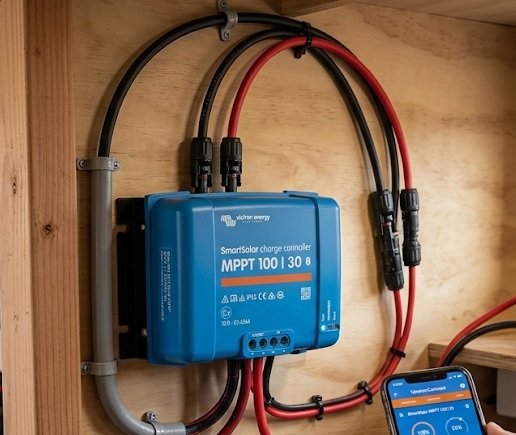
Victron Energy SmartSolar MPPT 100/30 – Best Overall Choice
The Victron SmartSolar MPPT 100/30 is the recommended charge controller for precise voltage management. Its Bluetooth app displays real-time charging voltage, letting you verify exactly when your battery hits 14.4V. Ideal for 12V and 24V systems, it supports lithium, gel, and AGM batteries with customizable charge profiles.
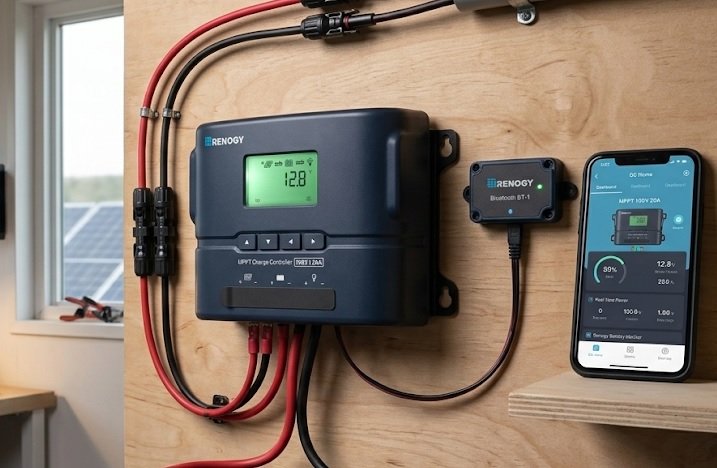
Renogy Rover 40A MPPT Charge Controller – Best Budget Option
The Renogy Rover 40A offers excellent value for solar setups needing accurate voltage regulation. It automatically detects 12V or 24V systems and displays charging voltage on its LCD screen. This best option for beginners handles lead-acid and lithium batteries, preventing overcharge above 14.6V with built-in protection.
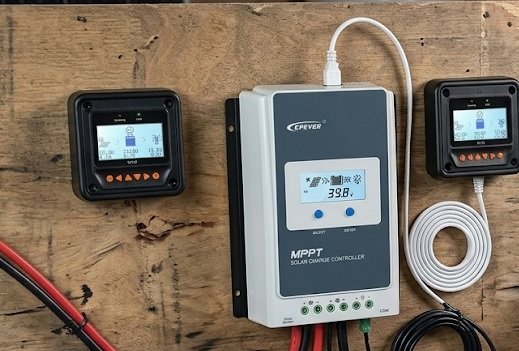
EPEver Tracer AN 4210 – Best for Large Solar Arrays
The EPEver Tracer AN 4210 is ideal for larger off-grid systems requiring 40A capacity. It delivers precise charging voltages up to 14.8V with selectable profiles for flooded, sealed, and lithium batteries. Its advanced MPPT algorithm boosts charging efficiency by 30%, making it perfect for demanding residential installations.
Understanding Solar Battery Charging Voltage by Battery Type
Charging voltage varies significantly across battery chemistries. Knowing your battery’s specific requirements prevents damage and maximizes performance.
Lead-Acid Battery Charging Voltages
Flooded, gel, and AGM batteries follow distinct voltage profiles during charging. Each type requires different set points to avoid sulfation or water loss.
- Flooded lead-acid: Charges at 14.4V–14.8V, needs equalization at 15.5V monthly
- Gel batteries: Lower charging voltage of 14.0V–14.2V prevents bubble formation
- AGM batteries: Charges at 14.4V–14.6V with tight voltage tolerances
Lithium Battery Charging Voltages
LiFePO4 batteries charge at higher voltages than lead-acid equivalents. Most 12V lithium batteries reach 14.2V to 14.6V before the BMS disconnects charging.
- Bulk phase: Constant current raises voltage to 14.2V–14.6V
- Absorption phase: Voltage holds steady while current tapers
- Float phase: Drops to 13.4V–13.6V for maintenance
Voltage Comparison Table
| Battery Type | Bulk Voltage | Float Voltage |
|---|---|---|
| Flooded Lead-Acid | 14.4V–14.8V | 13.2V–13.4V |
| Gel | 14.0V–14.2V | 13.2V–13.4V |
| AGM | 14.4V–14.6V | 13.2V–13.4V |
| LiFePO4 | 14.2V–14.6V | 13.4V–13.6V |
Quick Summary
- Lead-acid batteries charge between 14.0V and 14.8V
- Lithium batteries charge between 14.2V and 14.6V
- Always match charge controller settings to battery chemistry
What Voltage Should a Solar Battery Read While Charging?
Voltage readings change constantly during the charging process. Understanding each stage helps you confirm your system works correctly.
Voltage Readings During Each Charging Stage
A solar battery passes through three distinct charging phases. Each phase shows a different voltage reading on your meter or controller display.
- Bulk stage: Voltage climbs steadily from 12.0V toward 14.4V as the battery accepts full current
- Absorption stage: Voltage holds at 14.2V–14.8V while current gradually decreases
- Float stage: Voltage settles at 13.2V–13.6V to maintain full charge safely
Normal Voltage Ranges at a Glance
- 12V system charging: 13.6V to 14.8V (normal range)
- 24V system charging: 27.2V to 29.6V (double the 12V values)
- 48V system charging: 54.4V to 59.2V (quadruple the 12V values)
Readings below 13.0V during peak sunlight suggest a charging problem. Readings above 15.0V indicate a faulty controller or overcharge risk.
Why Charging Voltage Is Higher Than Resting Voltage
A charging battery always reads higher than its resting voltage. For example, a 12V battery at rest shows 12.6V–12.8V when full.
During charging, the controller pushes voltage upward to force current into the battery. This voltage differential drives the chemical reactions that store energy.
Quick Summary
- Charging voltage always exceeds resting voltage
- 12V batteries charge between 13.6V and 14.8V
- Voltage above 15.0V signals a controller fault
Factors That Affect Solar Battery Charging Voltage
Charging voltage rarely stays constant in real-world conditions. Several variables shift the numbers you see on your controller display.
Temperature Effects on Charging Voltage
Battery voltage responds directly to temperature changes. A temperature-compensated charger adjusts output to protect the battery.
- Cold batteries: Require higher charging voltage (up to 15.0V in freezing conditions)
- Hot batteries: Need lower voltage (as low as 13.8V in high heat)
- Compensation rate: Roughly -0.03V per cell for every 10°C above 25°C
Charge Controller Type and Voltage Accuracy
Your controller type determines how precisely voltage reaches the battery. PWM and MPPT controllers behave very differently.
- PWM controllers: Pull panel voltage down to battery level, wasting excess power
- MPPT controllers: Convert excess voltage into extra current for faster charging
- Voltage sensing: Controllers with remote sensing read true battery voltage, not cable losses
Solar Panel Output and Sunlight Conditions
Panel output fluctuates with weather, shading, and panel angle. Cloudy days may drop charging voltage below 13.0V, slowing the charge.
Undersized arrays struggle to reach absorption voltage. A system that never exceeds 13.8V will chronically undercharge lead-acid batteries.
Quick Summary
- Temperature shifts charging voltage by up to 1.0V
- MPPT controllers deliver more accurate, efficient charging
- Shading and weather directly reduce charging voltage
How to Monitor and Test Your Solar Battery Charging Voltage
Regular voltage checks catch problems before they damage your battery. Follow these proven methods to verify charging performance.
Tools You Need for Voltage Testing
Accurate testing requires the right equipment. Cheap tools often misread voltage by 0.2V or more, leading to wrong conclusions.
- Digital multimeter: Measures voltage directly at battery terminals with 0.01V precision
- Clamp meter: Reads charging current without disconnecting cables
- Battery monitor shunt: Tracks voltage and state of charge continuously
- Controller app: Displays live voltage data via Bluetooth or Wi-Fi
Step-by-Step Voltage Testing Process
Test your system during peak sunlight for the most accurate readings. Follow this sequence for reliable results.
- Set your multimeter to DC voltage mode (20V range for 12V systems)
- Touch the red probe to the positive terminal and black probe to the negative
- Record the reading while the battery is actively charging
- Compare your result against the expected range for your battery type
- Repeat the test at the controller terminals to check for voltage drop
Warning Signs of Voltage Problems
- Voltage stuck below 13.0V: Panel shading, faulty wiring, or controller failure
- Voltage exceeding 15.0V: Controller malfunction risking battery damage
- Voltage drops under load: Weak or aging battery nearing end of life
- Erratic readings: Loose connections or corroded terminals
Quick Summary
- Test voltage during peak sunlight for accuracy
- Readings below 13.0V or above 15.0V signal problems
- Compare controller and battery readings to detect voltage drop
Common Solar Battery Charging Voltage Problems and Fixes
Voltage issues are the most frequent complaint among solar owners. Most problems trace back to a handful of correctable causes.
Battery Won’t Reach Full Charging Voltage
A battery that stalls below 14.0V rarely reaches full charge. Chronic undercharging gradually destroys lead-acid batteries through sulfation.
- Undersized solar array: Add more panels to increase charging current
- Excessive voltage drop: Use thicker cables and shorten wire runs
- Wrong charge profile: Select the correct battery type in controller settings
- Partial shading: Trim obstructions or relocate panels
Voltage Rises Too High During Charging
Readings above 15.0V for a 12V system indicate overcharging. This boils electrolyte in flooded batteries and damages lithium cells.
- Verify controller settings: Confirm the correct voltage set points
- Check temperature sensor: A faulty sensor blocks voltage compensation
- Test the controller: Replace units that fail to regulate output
- Inspect for loose connections: Poor contacts cause voltage spikes
Voltage Fluctuates Erratically
Jumping readings usually point to connection problems rather than battery failure. Tighten every terminal and inspect for corrosion.
Corroded terminals add resistance that distorts voltage readings. Clean connections with a wire brush and apply dielectric grease before reassembly.
Quick Summary
- Undercharging below 14.0V causes permanent sulfation
- Overcharging above 15.0V destroys batteries quickly
- Clean, tight connections prevent erratic voltage readings
Optimal Charging Voltage Settings for Longer Battery Life
Correct voltage settings directly extend battery lifespan. Small adjustments to your charge controller deliver measurable long-term gains.
Recommended Voltage Set Points by Battery Type
Use these proven set points as a starting baseline. Always confirm exact values with your battery manufacturer’s datasheet.
| Battery Type | Absorption | Float | Equalize |
|---|---|---|---|
| Flooded Lead-Acid | 14.6V–14.8V | 13.2V–13.4V | 15.5V |
| Gel | 14.0V–14.2V | 13.2V–13.4V | Not recommended |
| AGM | 14.4V–14.6V | 13.2V–13.4V | 14.8V (rare) |
| LiFePO4 | 14.2V–14.6V | 13.4V–13.6V | Not applicable |
Best Practices to Maximize Battery Lifespan
- Enable temperature compensation: Adjusts voltage automatically in extreme conditions
- Avoid deep discharges: Recharge before dropping below 50% state of charge
- Limit absorption time: Cap at 2–4 hours to prevent overcharging
- Store at partial charge: Keep batteries at 50–70% during long storage
- Equalize flooded batteries monthly: Prevents acid stratification and sulfation
Why Voltage Precision Matters
A 0.3V error may seem trivial but compounds over hundreds of cycles. Slightly high voltage shortens life through grid corrosion and water loss.
Slightly low voltage leaves plates sulfated and capacity permanently reduced. Precision charging is the single most effective lifespan extender.
Quick Summary
- Match absorption and float voltages to your exact battery chemistry
- Temperature compensation prevents seasonal over and undercharging
- Even 0.3V errors shorten battery life over time
Charging Voltage Differences Across Solar System Sizes
Voltage scales proportionally with system size. A 12V battery charges at 14.4V, while a 48V bank charges at 57.6V for the same relative level.
12V, 24V, and 48V Charging Voltage Ranges
Each system voltage multiplies the base 12V values. Multiply by two for 24V systems and by four for 48V banks.
| System Voltage | Bulk/Absorption Range | Float Range |
|---|---|---|
| 12V | 13.6V–14.8V | 13.2V–13.6V |
| 24V | 27.2V–29.6V | 26.4V–27.2V |
| 48V | 54.4V–59.2V | 52.8V–54.4V |
Series vs Parallel Battery Connections
How you wire batteries changes the voltage your charger must deliver. Series connections add voltage, while parallel connections add capacity.
- Series wiring: Two 12V batteries in series create a 24V bank charging at 28.8V
- Parallel wiring: Two 12V batteries in parallel stay at 12V but double amp-hours
- Series-parallel: Combines both to reach target voltage and capacity
Why Higher Voltage Systems Charge More Efficiently
Higher voltage systems carry the same power with lower current. Reduced current means thinner cables, less voltage drop, and higher overall efficiency.
A 48V system loses far less energy over long cable runs than a comparable 12V setup. This makes higher voltage ideal for larger off-grid installations.
Quick Summary
- Charging voltage scales with system voltage (12V, 24V, 48V)
- Series wiring raises voltage; parallel wiring raises capacity
- Higher voltage systems charge more efficiently over long runs
Conclusion: Mastering Solar Battery Charging Voltage
Solar batteries charge between 13.6V and 14.8V for 12V systems, with exact values depending on chemistry and temperature. Matching your controller settings to your battery type prevents damage and maximizes lifespan.
Always verify charging voltage during peak sunlight. Precision charging is the single best way to protect your investment.
Grab your multimeter today and test your system. Small corrections now prevent costly replacements later.
With the right voltage settings, your solar batteries will deliver reliable power for years.
Frequently Asked Questions About Solar Battery Charging Voltage
What voltage should a 12V solar battery read while charging?
A 12V solar battery should read between 13.6V and 14.8V while actively charging. The exact reading depends on the charging stage and battery chemistry.
During bulk charging, voltage climbs toward 14.4V. In float mode, it settles near 13.2V–13.6V. Readings outside this range signal a problem.
Is 14.5 volts too high for charging a battery?
No, 14.5V is normal for most 12V batteries during absorption charging. Flooded and AGM batteries safely accept this voltage in the absorption phase.
However, sustained voltage above 14.8V causes damage. Gel batteries prefer lower limits of 14.0V–14.2V, so always match settings to your battery type.
How do I know when my solar battery is fully charged?
A fully charged 12V battery rests at 12.6V to 12.8V with no load. During charging, it reaches absorption voltage and current drops to near zero.
Many charge controllers indicate full charge when current falls below 2% of capacity. A battery monitor shunt gives the most accurate state-of-charge reading.
Why is my solar battery only charging to 13 volts?
Charging that stalls at 13.0V usually indicates insufficient solar input. Shading, dirty panels, or an undersized array prevent reaching absorption voltage.
Check for excessive voltage drop across cables and connections. Also verify your controller’s charge profile matches your battery chemistry.
What is the best way to charge a lithium solar battery?
Charge lithium batteries to 14.2V–14.6V using an MPPT controller with a lithium profile. Lithium batteries don’t require equalization or float charging.
Most LiFePO4 batteries include a BMS that disconnects charging at full capacity. Avoid charging below freezing temperatures to prevent permanent cell damage.
Can a solar panel overcharge a battery?
Yes, without a charge controller, solar panels can overcharge and destroy batteries. Panels output 18V–22V, far above safe battery charging levels.
A quality charge controller regulates voltage and prevents overcharging. Never connect panels directly to batteries except in tiny trickle-charge setups.
How does temperature affect solar battery charging voltage?
Cold batteries need higher charging voltage, while hot batteries need lower voltage. Temperature compensation adjusts output automatically to prevent damage.
Most controllers apply roughly -0.03V per cell for every 10°C above 25°C. Without compensation, hot batteries overcharge and cold batteries undercharge.
What voltage should a 24V solar system charge at?
A 24V solar system charges between 27.2V and 29.6V, exactly double the 12V values. Float voltage sits around 26.4V–27.2V.
Always confirm exact set points with your battery manufacturer. The same chemistry rules apply, just at doubled voltage levels.